
✅ HIGHLIGHTS – High-efficiency fertilizers: the revolution in plant nutrition
- • What are they? High-efficiency fertilizers maximize the percentage of nutrients actually used by the crop, reducing losses from leaching, volatilization, or soil fixation.
- • Key technologies: Includes controlled release, stabilization with inhibitors, nanotechnology, natural chelation, and synergies with biostimulants.
- • Quelagrow difference: Our product range (fertilizers, soil improvers, foliar fertilizers, deficiency correctors, plant growth regulators, amino acids, and biostimulants) incorporates advanced technologies that guarantee superior efficiency.
- • Proven results: Higher nutrient utilization (up to 80% compared to 20-30% conventional), reduced number of applications, lower environmental impact, and greater profitability for the farmer.
Growing pressure on natural resources, volatility in raw material prices, and the demand for increasingly sustainable agriculture are redefining the concept of fertilization. It is no longer enough to supply nutrients; it is crucial to do so as efficiently as possible. High-efficiency fertilizers have become the key tool to achieve this goal, enabling increased productivity, reduced environmental impact, and optimized farm profitability. This technical guide provides an in-depth analysis of what they are, how they work, and how they can transform your crop nutrition strategy.
What makes a fertilizer “high-efficiency”?
The problem with conventional fertilizers: significant losses
Traditional fertilizers, generally highly soluble, have very limited use efficiency. It is estimated that, under average conditions, up to 80% of applied nitrogen can be lost through volatilization (ammonia emission into the atmosphere), denitrification (nitrous oxide emission, a potent greenhouse gas), or leaching (nitrate runoff into groundwater). Phosphorus, on the other hand, tends to become fixed in the soil, forming insoluble compounds that the plant cannot absorb, while potassium can become trapped between clay layers. These losses not only represent economic waste but also a serious environmental problem.
Technologies that make the difference
High efficiency is achieved through the application of technologies that protect nutrients and release them in sync with crop demand:
- Controlled release: Using polymer or sulfur coatings, nutrients are released gradually, conditioned by soil temperature and moisture. This allows a single application for the entire crop cycle.
- Stabilization with inhibitors: The incorporation of urease inhibitors (such as NBPT) slows down urea hydrolysis, reducing volatilization losses. Nitrification inhibitors, on the other hand, maintain nitrogen in ammoniacal form, which is less prone to leaching.
- Nanotechnology: Nanofertilizers, with particle sizes thousands of times smaller than conventional ones, multiply the contact surface and facilitate penetration into plant tissues, drastically improving absorption.
- Natural complexation and chelation: Certain organic substances (humic acids, lignosulfonates, amino acids) protect nutrients by forming stable complexes that prevent reactions with the soil and facilitate transport to the root.
- Synergy with biostimulants: Combining fertilizers with biostimulants enhances the plant’s metabolic processes, improving its ability to absorb and assimilate available nutrients.
Efficiency indicators
Several technical parameters are used to evaluate fertilizer performance:
- NUE (Nitrogen Use Efficiency): Kilograms of production obtained per unit of nitrogen applied. A higher value indicates greater efficiency.
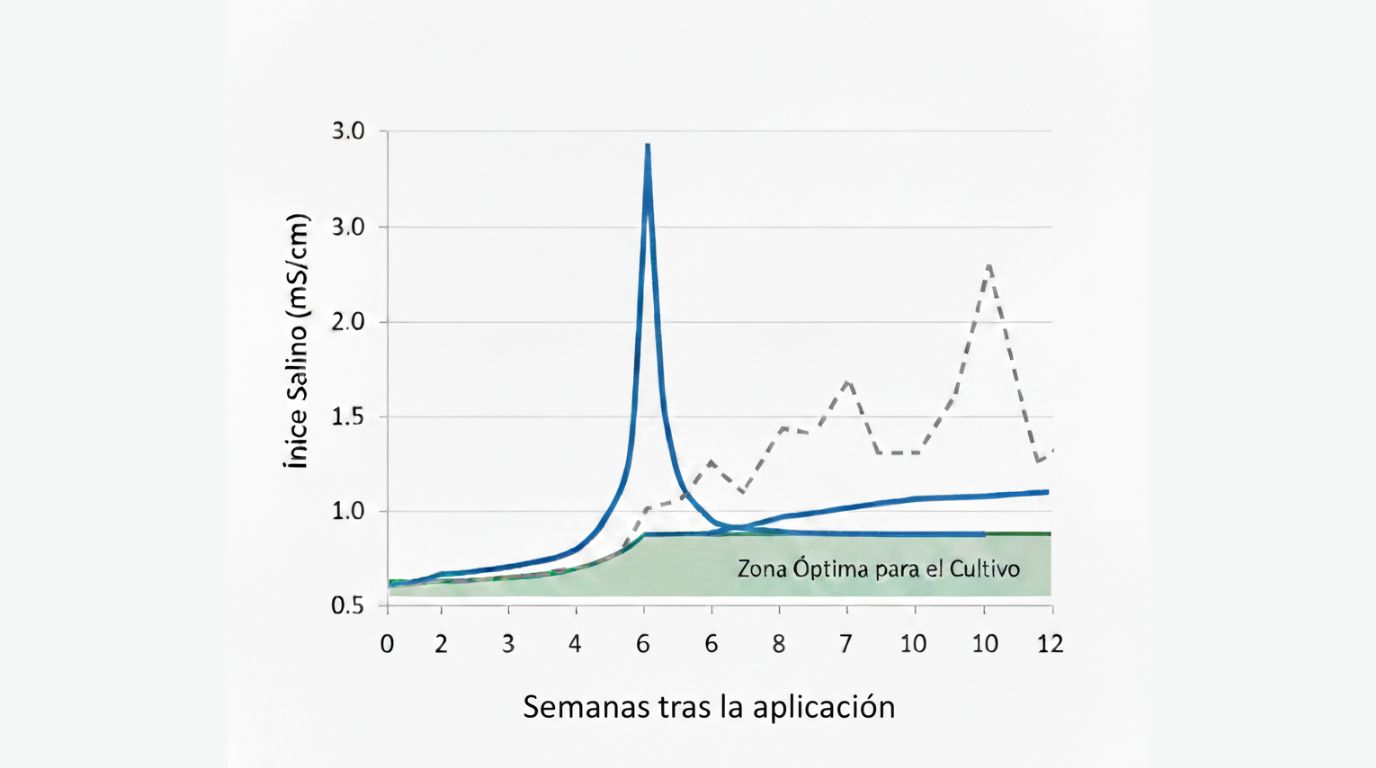
- Salinity index: Measures the increase in osmotic pressure in the soil solution. A low index is crucial for localized applications, as it prevents phytotoxicity damage to roots.
- Release rate: The release kinetics must adjust to the crop’s absorption curve, with more intense release during periods of peak demand.

Benefits of high-efficiency fertilizers for your crop and profitability
- Maximum return on every euro invested: By reducing losses from leaching, volatilization, and fixation, each unit of applied nutrient translates into greater production. This means that with less product, you achieve the same or higher yield, optimizing your fertilizer investment.
- Fewer applications, greater savings in labor and machinery: Controlled-release and stabilized fertilizers extend the effect of fertilization, reducing the need for multiple passes. This translates into fewer tractor hours, lower fuel consumption, and more time available for other tasks.
- More vigorous and uniform crops: Synchronizing nutrient release with crop demand prevents peaks of deficiency or excess, maintaining balanced growth. This results in greater crop uniformity and improved final product quality (size, color, soluble solids content).
- Greater resistance to abiotic stress: Balanced and efficient nutrition strengthens the plant against stress situations such as drought, high temperatures, or salinity. Biostimulants and amino acids in high-efficiency solutions enhance the plant’s natural defense mechanisms.
- Reduced environmental impact: By minimizing nitrogen losses (especially in the form of ammonia and nitrous oxide, potent greenhouse gases) and preventing nitrate leaching into groundwater, high-efficiency fertilizers contribute to more environmentally friendly agriculture aligned with the goals of the European Green Deal.
- Improved long-term soil health: Some high-efficiency technologies, such as organomineral fertilizers and biostimulants, not only nourish the plant but also feed the soil’s microbial life and improve its structure, creating a virtuous cycle of increasing fertility.
- Certifications and access to premium markets: Reducing the carbon footprint and efficient use of inputs facilitate obtaining sustainability certifications (GlobalG.A.P., carbon footprint, etc.), opening the door to increasingly demanding markets regarding the origin and quality of food.
High-efficiency fertilizer solutions for every need
1. High-efficiency fertilizers
Conventional fast-release fertilizers have the serious drawback that a large portion of nutrients are lost before the plant can use them. Agricultural fertilizers with high efficiency incorporate technologies that minimize these losses, such as controlled release (using coatings that synchronize nutrient delivery with crop demand) or stabilization with inhibitors (which reduce ammonia volatilization and nitrate leaching). The result is much higher utilization, reaching up to 80% of applied nutrients, reducing the need for additional inputs and minimizing environmental impact.
2. Soil improvers
Fertilization efficiency depends largely on soil health. Soil improvers, especially those rich in humic and fulvic acids, act by increasing the soil’s cation exchange capacity (CEC), allowing it to retain more nutrients and make them available to roots gradually. They also stimulate microbial activity, improve soil structure (aggregation, porosity, aeration), and increase water-holding capacity. All this creates an optimal root environment for applied fertilizers to be fully utilized.
3. Liquid foliar fertilizers
Foliar fertilization is a fast and efficient route to correct nutritional deficiencies at critical crop stages. High-efficiency foliar fertilizers are formulated with substances that facilitate nutrient penetration through the leaf cuticle, such as amino acids or plant extracts. This allows almost immediate assimilation, ideal for resolving acute deficiencies or complementing base fertilization during high-demand phases (flowering, fruit set, fruit filling).
4. Deficiency correctors
When a specific nutritional deficiency limits crop potential, deficiency correctors offer a fast and precise solution. Their efficacy lies in the chemical form of the nutrient: formulations complexed or chelated with natural agents (such as lignosulfonates, humic acids, or amino acids) that protect the element from unwanted reactions in the soil or inside the plant, ensuring its availability until absorbed. This is especially critical for micronutrients such as iron, manganese, zinc, or copper.
5. Plant growth regulators
Plant growth regulators are substances that, applied in very low doses, modify key physiological processes of the plant. In the context of high efficiency, their role is to maximize crop yield from available resources. They act by stimulating root development (improving soil exploration and nutrient uptake), regulating flowering and fruit set, or redistributing photoassimilates toward commercially interesting organs. They are therefore tools that multiply the efficiency of the entire fertilization strategy.
6. Organic amino acids
Agricultural amino acids are the building blocks of proteins and play essential roles in plant metabolism. High-efficiency amino acids, obtained through controlled enzymatic hydrolysis, are directly assimilable by the plant and act as biostimulants: they improve germination, rooting, flowering, and fruit quality. But their most relevant role in terms of efficiency is their ability to chelate nutrients, acting as natural carriers that facilitate the absorption and movement of mineral elements within the plant. They also increase tolerance to abiotic stress (drought, frost, salinity), reducing production losses under adverse conditions.
7. Biostimulants
Biostimulants constitute a broad and rapidly developing category. They include algae extracts, beneficial microorganisms (mycorrhizae, Trichoderma, plant growth-promoting bacteria), protein hydrolysates, and other natural substances. Their action is not directly nutritional; rather, they stimulate the biological processes of the soil and the plant, improving nutrient use efficiency, increasing stress tolerance, and enhancing crop quality. Applied in combination with fertilizers, they act as “boosters” that multiply the effect of fertilization, allowing dose reductions without compromising production.
HIGH-YIELD FERTILIZERMAIN FUNCTIONHIGH-EFFICIENCY KEY
Case study: scientific validation of high-efficiency fertilization efficiency
This was demonstrated in a tomato crop trial conducted during the 23-24 campaign, in an irrigated plot in the province of Almería, to compare conventional fertilization strategy versus a complete strategy based on high-efficiency products.
Trial design
The trial was designed to compare two fertilization strategies in a pear-type tomato crop:
- Conventional strategy (control): Base fertilization with a conventional NPK complex (8-15-15) at a rate of 800 kg/ha, plus top dressing with urea (46-0-0) in three applications, totaling 200 UFN/ha.
- High-efficiency strategy: Base fertilization with a fertilizer stabilized with nitrification inhibitors, plus a soil improver based on humic acids (300 kg/ha), top dressing with a controlled-release fertilizer, and biweekly applications of a biostimulant with amino acids and algae extracts.
How does high-efficiency technology work?
The high-efficiency strategy is based on several principles: the soil improver increases cation exchange capacity, retaining nutrients in available forms. The stabilized fertilizer reduces leaching and volatilization losses, while the controlled-release fertilizer synchronizes inputs with crop demand. Biostimulants, in turn, enhance root activity and nutrient absorption, as well as improving tolerance to environmental stress.
StrategyBaseTop dressingTotal N units
Results: crop monitoring
Using satellite images of the NDVI index, it was possible to compare crop vigor in both strategies. In the high-efficiency fertilization zone, the crop showed greater vigor and uniformity from the early stages, with especially notable differences during the flowering and fruit set period, where synchronized nutrient availability made the difference.
Productive results
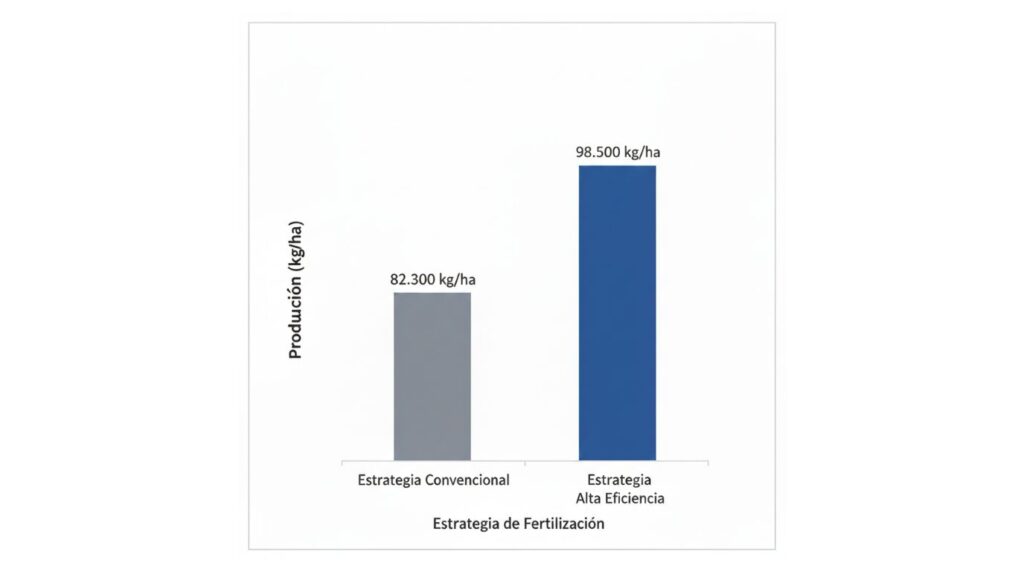
The high-efficiency strategy achieved a production of 98,500 kg/ha, while the conventional strategy reached 82,300 kg/ha. This represents a production increase of +16,200 kg/ha, or 19.7% more production.
Efficiency analysis (NUE)
Nitrogen use efficiency (NUE) was calculated as the kilograms of tomatoes produced per unit of nitrogen applied. The conventional strategy yielded 411.5 kg of tomatoes per N unit. In the high-efficiency strategy, with 30% less nitrogen applied (140 N units vs. 200), 703.6 kg/N unit were achieved, representing an efficiency increase of +71%.
Environmental impact and carbon footprint
This greater efficiency also translated into a drastic reduction in environmental impact. Calculating the carbon footprint generated by fertilization using the Cool Farm Tool, the high-efficiency strategy generated 46% less greenhouse gas emissions per ton produced, thanks to reduced nitrogen losses and lower input consumption.
ParameterConventional strategyHigh-efficiency strategyDifference
Farmer profitability
The economic analysis, considering the price of tomatoes (€0.50/kg) and fertilizer costs, yields an additional net benefit of +€8,100/ha for the high-efficiency strategy, thanks to input savings and increased production. The return on investment is therefore much higher.
How to select the right high-efficiency fertilizer for your crop?
Step 1: Accurate diagnosis (soil analysis and crop needs)
Before choosing any product, it is essential to know the starting point. A complete soil analysis (pH, organic matter, texture, nutrient levels, CEC) and knowledge of the specific needs of the crop at each stage are the foundation of any efficient strategy.
Step 2: Identify the critical moment (base, top dressing, stress moments)
Not all products are suitable for all times. Controlled-release fertilizers are ideal for base application, while biostimulants and amino acids are most useful during stress periods or key phenological stages (flowering, fruit set).
Step 3: Choose the appropriate technology (slow release, stabilized, biostimulant, etc.)
Depending on the crop, soil, and climatic conditions, the best-suited technology should be chosen. Sandy soils with high rainfall particularly benefit from controlled release; clay soils may require improvers; high-value crops respond very well to combination with biostimulants.
Step 4: Calculate the optimal dose (adjusted to expected production)
High efficiency allows total doses to be reduced without compromising production, but correct adjustment is essential. A calculation based on crop extraction, soil analysis, and productive potential is the best guarantee.
Step 5: Precision application (localized, fertigation, variable rate)
The final key is correct application. Localized application (along the planting line) maximizes contact with roots. Fertigation allows for fractionation and real-time adjustment of inputs. Variable rate application, guided by productivity maps, takes efficiency to the highest level.
Frequently asked questions about high-efficiency fertilizers
Are they compatible with organic farming?
It depends on the specific technology. Many controlled-release fertilizers use coatings that are not permitted in organic farming. However, other technologies such as biostimulants, amino acids, natural-origin soil improvers, and certain organic fertilizers (organic or natural minerals) are compatible and constitute key tools in organic production. Always verify the product certification to implement sustainable organic fertilization techniques compatible with each crop.
Can I mix them with other products?
Generally, yes, but compatibility tests are recommended, especially with controlled-release fertilizers, as some coatings may be affected by certain products. Biostimulants and amino acids are usually very compatible and their mixing with fertilizers is recommended to enhance their effect.
How long does their effect last?
It varies according to the technology. Controlled-release fertilizers can last between 2 and 8 months, depending on the coating and temperature and humidity conditions. Stabilized fertilizers have an efficiency window of several weeks. Biostimulants and amino acids have a more immediate effect, and their duration depends on the product and dosage.
Is the investment worthwhile?
Absolutely, as case studies demonstrate. Although the price per kilo of product may be higher than conventional fertilizer, the greater efficiency (more production with fewer inputs) and the reduction in applications generate a much higher net economic benefit. Added to this are the intangible benefits of reduced environmental impact and improved soil health.
Innovating for sustainable and profitable agriculture with high-efficiency natural fertilizers
At Quelagrow, we are committed to the agricultural revolution through efficient fertilization. Therefore, after a technical and in-depth analysis of each situation, we develop fertilization plans that combine the application of high-efficiency fertilizers with precision agriculture techniques. As agricultural fertilizer manufacturers, we help farmers maximize their profitability while reducing environmental impact and contributing to building a more sustainable agricultural future.
“High-efficiency fertilization is not an expense; it is the most profitable investment to ensure the productivity and sustainability of your farm.”