✅ KEY TAKEAWAYS – Humic acid: the complete guide
- • What it is: humic acid is one of the three fractions of humic substances, the most stable and evolved organic matter in the soil. Together with fulvic acid and humin, it makes up humus.
- • What it does: it improves soil structure and the soil’s ability to hold water and nutrients, and it supports root development and the uptake of the fertilizers we already apply.
- • Humic vs fulvic: humic acids are larger molecules that work mainly in the soil; fulvic acids are smaller, soluble at any pH, move more easily and can be applied as a foliar spray.
- • Source: the most common commercial raw material is leonardite, an oxidized lignite that is particularly rich in humic acid.
- • How to apply it: through fertigation, flood irrigation or foliar application, at rates that depend on the format (liquid, soluble solid or foliar biostimulant) and the crop.
- • Quelagrow solutions: QUELAFERT® HUMIC 20 (liquid), QUELAFERT® HUMIC GOLD (soluble solid) and QUELAFERT® QZ (root and foliar), all manufactured in-house.
Few inputs appear as often in fertilization programs, and raise as many questions, as humic acid. It is sold as a liquid and as a solid, with percentages that are not always comparable, and it is credited with effects ranging from “loosening” the soil to multiplying root mass. In this guide we explain exactly what humic acid is, what it does in the soil and in the plant, how it differs from fulvic acid, where it comes from and how to apply it properly. We do so from our experience as a fertilizer manufacturer that formulates and produces its own soil conditioners.
What is humic acid?
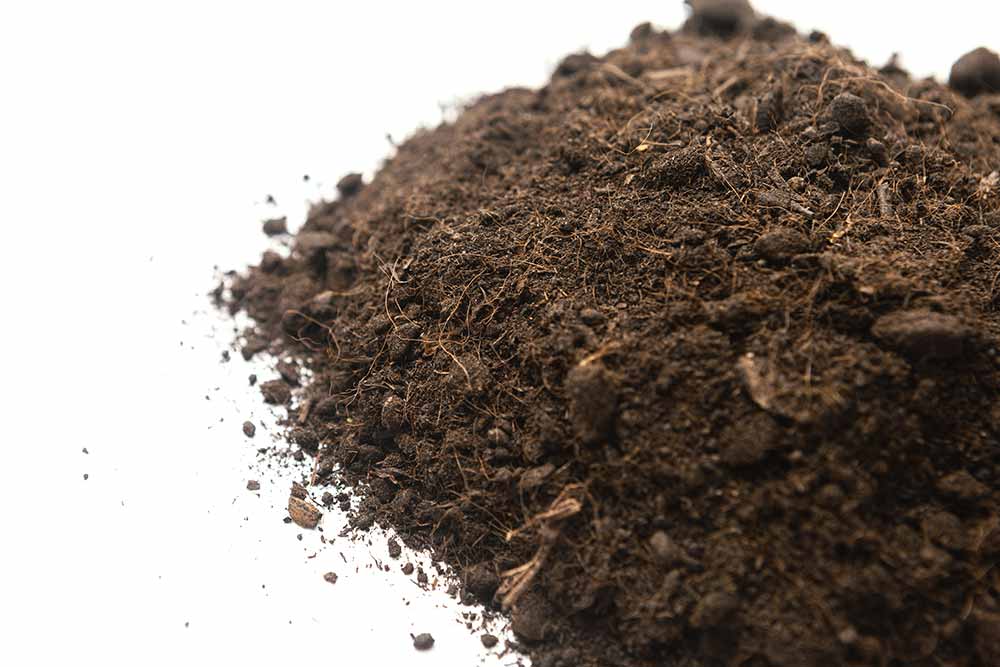
Humic acids are complex organic compounds formed as plant and animal residues decompose in the soil. They do not have a single chemical formula: they are mixtures of large molecules, rich in carboxyl and phenolic groups, which give them their characteristic ability to hold cations and to bind to minerals and nutrients. Their color ranges from dark brown to black, the same color we associate with soil rich in organic matter.
Humic substances: humic acid, fulvic acid and humin
To understand humic acid, it helps to place it within a broader group, humic substances. They are classically classified by their solubility at different pH levels, which gives three fractions:
- Humic acids: soluble in neutral or alkaline conditions, but they precipitate when the pH drops below 2.
- Fulvic acids: soluble at any pH. They are the fraction with the smallest molecular size and the greatest mobility.
- Humin: insoluble at any pH. It remains bound to the mineral fraction of the soil.
This classification is not just academic. It explains why commercial humic acids are extracted under alkaline conditions, why liquid products usually have a high pH and why mixes with very acidic solutions in the tank need care.
How it forms: humification
Humification is the slow transformation of fresh organic matter —roots, crop residues, manure— into stable humic substances. It is carried out by soil microorganisms, which first break down the simplest compounds and then reorganize the more resistant ones, such as lignin, into increasingly complex molecules. The result is humus that can remain in the soil for a long time and acts as a nutrient reserve and a support for biological activity. In soils with little organic matter, intensive tillage or a warm climate, this process does not keep up with losses, and that is where humic acid applications make sense.
What does humic acid do?
Humic acid is not a fertilizer in the classic sense: its value does not lie in the units of nitrogen, phosphorus or potassium it supplies, but in how it improves the soil and the efficiency of everything else we apply. That is why we classify it among soil conditioners. Its effects fall into four areas.
In the soil: structure, water retention and cation exchange capacity
Humic acids act as an organic “glue” between mineral particles and promote the formation of stable aggregates. In clay soils, this means a looser, better-aerated soil; in sandy soils, more cohesion and fewer leaching losses. In addition, thanks to their negatively charged functional groups, they increase the cation exchange capacity (CEC), that is, the soil’s ability to hold cations such as potassium, calcium or magnesium and release them to the roots later. Their porous structure also improves the water-holding capacity available to the crop.
In the plant: root development and nutrient uptake
The most visible effect in the field is on the roots. Humic acids stimulate the growth of secondary roots and root hairs, increasing the volume of soil the plant explores. On top of that, they can complex micronutrients such as iron, zinc or manganese, keeping them in available forms in soils where they tend to become locked up, such as calcareous soils. The practical result is better fertilizer use efficiency: the same unit of fertilizer reaches the plant more effectively.
In the soil microbiome
Humic substances also provide support and a carbon source for soil microbial life. A soil with more stable organic matter sustains more active and diverse microbial populations, which in turn take part in nutrient mineralization and in humification itself. This is especially important after aggressive practices such as soil disinfection, which we cover in our guide to soil disinfection without harming the microbiome.
Against drought and salt stress
A more developed root system and a soil with better structure and water retention cope better with dry spells. In saline soils or with poor-quality irrigation water, humic acids help maintain soil structure and root activity, although they do not replace specific salinity management. When sodium is the main problem, they are best combined with a salt displacer as part of a soil conditioner program.
Humic acid vs fulvic acid: the differences
Humic and fulvic acids come from the same organic matter and are almost always sold together, but they do not do exactly the same job. Knowing the differences helps you choose the product and the application method.
In practice, the two are usually combined: humic acids work on the soil and fulvic acids help nutrients reach the plant. That is why, when comparing products, the total is not enough: you also need to know how much is humic and how much is fulvic.
Leonardite: the source of commercial humic acid
Although humic substances can be extracted from peat, compost or lignite, the vast majority of humic acids used in agriculture come from leonardite.
What is leonardite?
Leonardite is an oxidation product of lignite, a low-rank coal, found in shallow layers close to coal deposits. This natural oxidation makes it a material particularly rich in humic acid, well above other organic sources, which is why it is the reference raw material for humic soil amendments. Not all leonardite is the same: its humic substance and impurity content varies from deposit to deposit.
From leonardite to product: extraction and purification
Raw leonardite has limited solubility. To obtain a product the crop can use, humic and fulvic acids are extracted under alkaline conditions, which dissolves them, and are separated from the mineral fraction and the insoluble humin. The quality of the raw material and of the extraction and purification process determines the final concentration, the stability of the product and something growers notice immediately in their irrigation system: whether it leaves residues or clogs filters and drippers.
Types of humic acid by format
Humic products come in three main formats. Each one fits a particular irrigation system or goal better.
Liquid humic acid
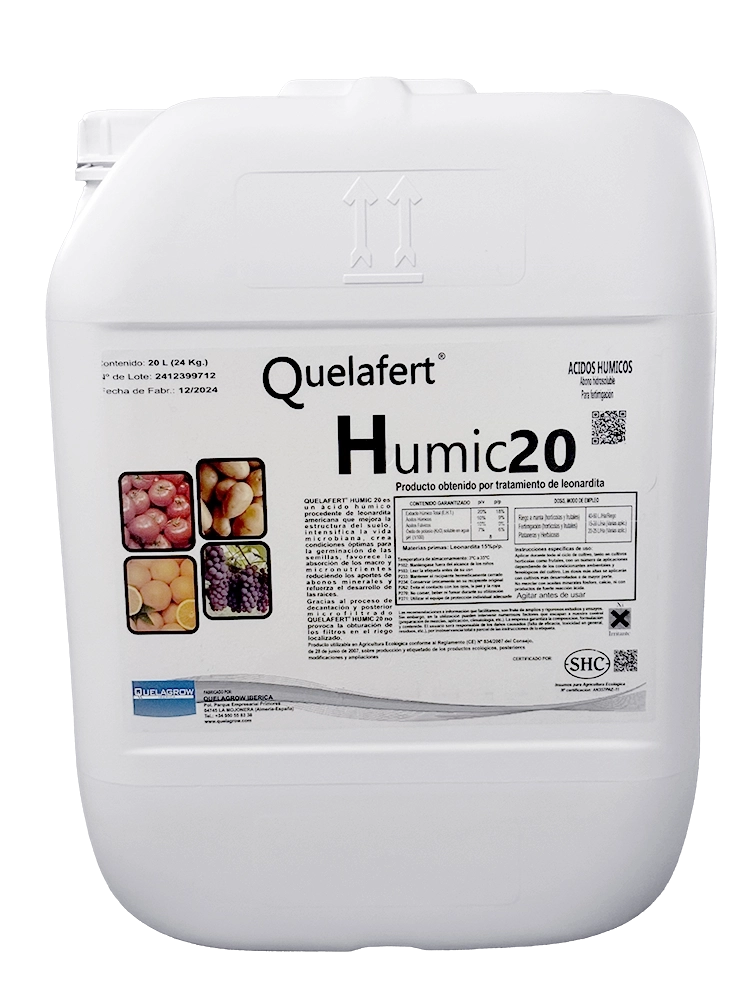
This is the most widely used format in fertigation. QUELAFERT® HUMIC 20 is our liquid humic acid fertilizer, made from purified American leonardite. It provides 20% total humic extract, split equally between humic acids (10%) and fulvic acids (10%), to work on soil structure and on nutrient availability for the plant at the same time.
Soluble solid humic acid
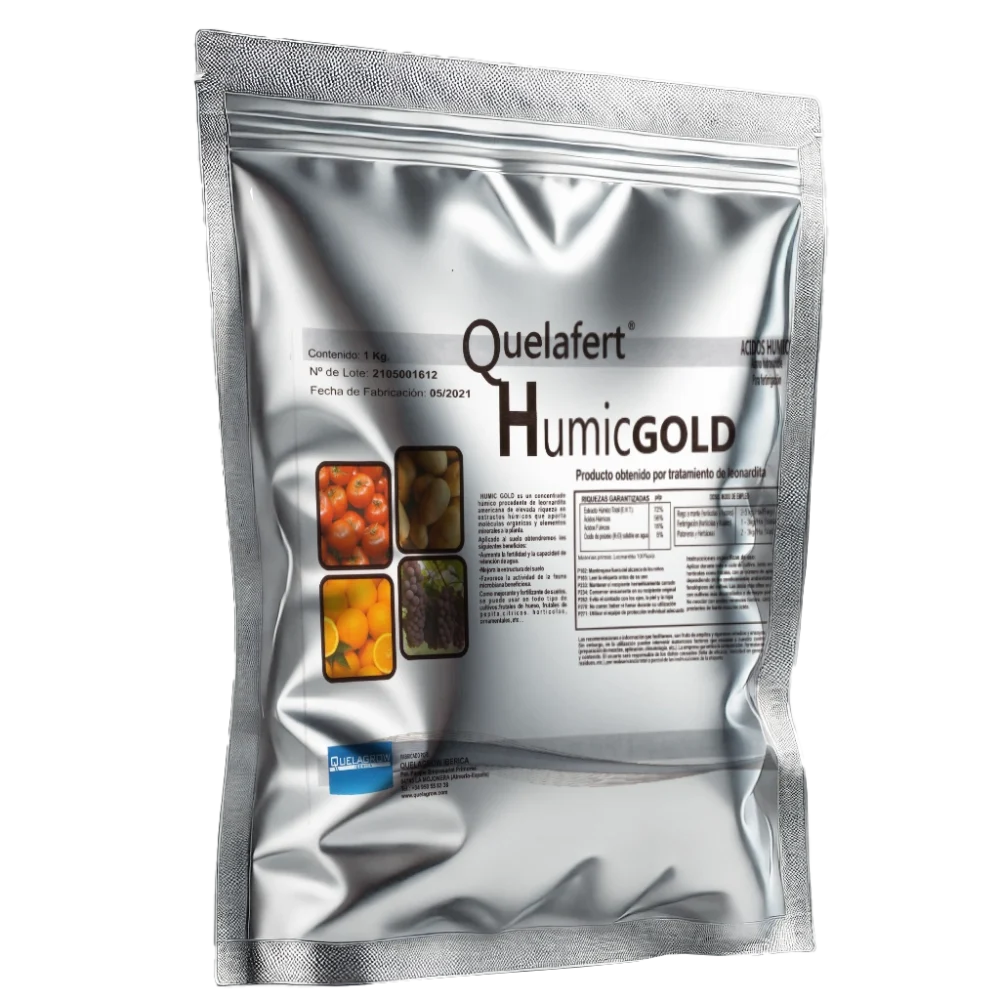
The solid format packs far more active matter per kilo. QUELAFERT® HUMIC GOLD is a soluble humic acid with 72% total humic extract (56% humic and 16% fulvic) and 8% potassium (K2O). In terms of its humic fraction, 3.5 kg is equivalent to about 20 L of a liquid humic product, and its solubility allows it to be used in drip irrigation without clogging filters. It comes in 1 kg and 5 kg packs.

Foliar humic acid and biostimulants
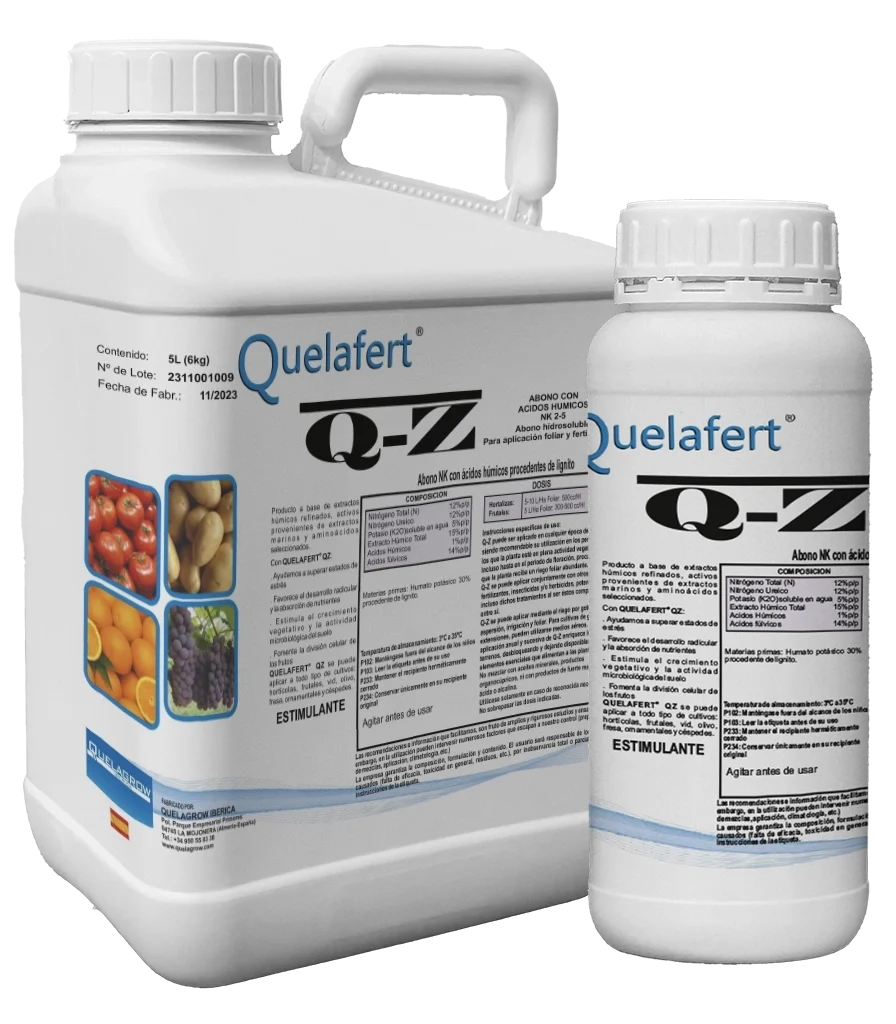
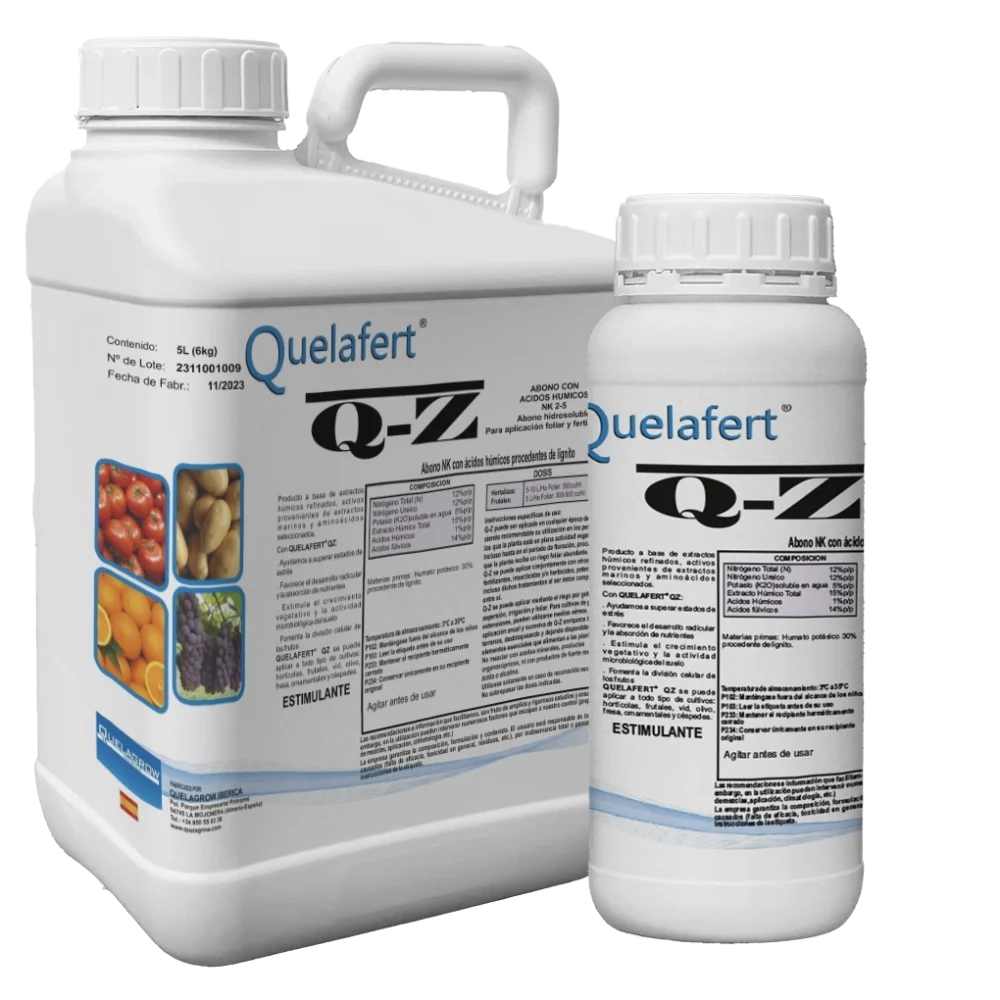
When, in addition to the soil, we want to act directly on the plant, biostimulants that combine humic substances with other active ingredients come into play. QUELAFERT® QZ is a liquid biostimulant based on refined humic extracts, amino acids and seaweed extracts, with 12.5% total humic extract (5% humic and 7.5% fulvic). It is designed to stimulate the root system and improve the crop’s response to salinity, cold, drought or nutrient lock-up, and it can be used both in fertigation and as a foliar humic acid application.
How to apply humic acid: rates, timing and method
A good product applied badly delivers little. The effectiveness of humic acid depends on it reaching the active root zone, at a time when the crop can use it, and without interference in the spray or mixing tank.
Fertigation and drip irrigation
This is the most efficient method: the product goes straight to the wetted bulb, where the roots are concentrated. We recommend splitting the rate into several applications over the crop cycle rather than applying it all at once, and injecting it in the middle part of the irrigation, so that the product does not stay in the lines or get washed below the root zone.
Foliar application
Foliar application makes sense with products rich in the fulvic fraction and formulated for this purpose, such as QUELAFERT® QZ. Apply during the cooler hours of the day, with good coverage and without exceeding the recommended rate.
Application timing
Applications pay off most when the roots are active or need to be activated: at transplanting and crop establishment, at bud break in tree and vine crops, during periods of high nutrient demand, and before or after stress events. In soils low in organic matter, a regular program throughout the season gives better results than a one-off application.
Reference rates by product
Rates depend on the crop, the soil and the irrigation system. These are the reference rates given on our product data sheets:
Tank-mix compatibility
- Avoid very acidic conditions: humic acids precipitate at very low pH, so they should not be mixed in concentrated form with acids or highly acidified solutions.
- Be careful with concentrated calcium: precipitates can form in stock solutions with a lot of calcium; it is better to inject them separately.
- QUELAFERT® QZ is compatible, according to its data sheet, with other fertilizers, insecticides and herbicides.
- Always run a jar test: before any new mix, we recommend a small-scale compatibility test.
How to choose a good humic acid
Two products both labelled “humic acid” can perform very differently. These are the criteria we look at when comparing:
- Total humic extract (THE) content: this is the figure that allows comparison. Check the declared percentage and whether it is expressed by weight or by volume.
- Humic-to-fulvic split: more humic to work on the soil; more fulvic if you are looking for mobility in the plant or foliar application.
- Raw material source: good-quality, well-purified leonardite gives richer and more stable products.
- Solubility and system cleanliness: in drip irrigation, the product must not leave residues or clog filters and drippers.
- Organic certification: if the farm is organic, the product must be certified. QUELAFERT® HUMIC 20 and QUELAFERT® HUMIC GOLD hold organic certification; we cover this in more detail in our guide to organic fertilization.
Quelagrow: humic acid and soil conditioners made in-house
At Quelagrow we formulate and manufacture our entire range of soil conditioners at our plant in Almería (Spain), from liquid and solid humic acids to organic amendments and salt displacers. Controlling the raw material and the process allows us to guarantee consistent concentrations and products suited to fertigation. We integrate them into nutrition programs alongside our high-efficiency fertilizers, and we work with distributors and agricultural dealers to adapt pack sizes, volumes and private-label options to each market.
Frequently asked questions about humic acid
Is humic acid a fertilizer?
Not strictly speaking. It is not applied for its nitrogen, phosphorus or potassium content, but as a soil conditioner and to improve fertilizer efficiency. Some products, such as QUELAFERT® HUMIC GOLD, also contain potassium, but their main role is still to improve the soil and nutrient uptake.
Is humus the same as humic acid?
No. Humus is the whole body of stable organic matter in the soil, and humic acids are only one of its fractions, together with fulvic acids and humin.
What does the total humic extract percentage mean?
It is the sum of humic and fulvic acids in the product. It is the figure that allows concentrations to be compared between products, as long as you take into account whether it is expressed by weight or by volume and how it is split between the two fractions.
In which soils does humic acid have the greatest effect?
In soils low in organic matter, sandy soils with poor water and nutrient retention, compacted clay soils and calcareous soils prone to micronutrient lock-up. Also in soils subject to intensive tillage or disinfection.
Is it better to apply raw leonardite or extracted humic acid?
For fertigation, extracted and purified humic acids. Raw leonardite has limited solubility, so it is not suitable for drip irrigation and its effect is slower.
Can humic acid be used in organic farming?
Yes, as long as the product is certified for organic farming. QUELAFERT® HUMIC 20 and QUELAFERT® HUMIC GOLD hold this certification and are part of our range of agricultural fertilizers.
Can humic acid be tank-mixed with other products?
In general yes, avoiding very acidic solutions and calcium-rich concentrates, with which it can precipitate. Before any new mix, we recommend a small-scale compatibility test.
Where can I buy humic acid in bulk?
At Quelagrow we manufacture and supply liquid and solid humic acids to distributors, agricultural dealers and large growers, with tailored pack sizes and a private-label option. You can see the full range in our soil conditioners category.