✅ KEY TAKEAWAYS – Best fungicide for potato late blight
- • What it is: potato late blight is caused by the oomycete Phytophthora infestans, a pathogen distinct from true fungi even though it’s managed within the same bioprotection strategy.
- • Two fronts: it attacks both foliage and tubers, with consequences in the field and during post-harvest storage.
- • Risk conditions: relative humidity above 90% and mild temperatures (50-68°F) sustained for several hours — watch closely after intermittent rain or persistent dew.
- • Solution: QUELAFERT® FOS-K, a potassium phosphite formulation with reinforcing action specifically against Oomycetes, applicable both foliarly and via root uptake.
- • Sustainable approach: potassium phosphite strengthens crop defenses with a low-residue profile, fitting a bioprotection strategy that’s more environmentally friendly than relying solely on synthetic fungicides.
What is potato late blight and how to recognize it
Potato late blight is, historically, one of the most impactful documented agricultural diseases: it was responsible for the 19th-century Irish famine, an episode that illustrates just how completely this pathogen can wipe out a harvest when conditions favor it and no action is taken in time. It’s caused by Phytophthora infestans, an oomycete — not a true fungus, though it shares much of its agronomic management with them — capable of spreading extremely fast once it finds enough moisture on plant tissue.
Recognizing late blight early is the difference between an effective preventive intervention and a hard-to-reverse crop loss. If your issue isn’t a fungal disease but an insect pest instead, check out our guide on biological pest control.
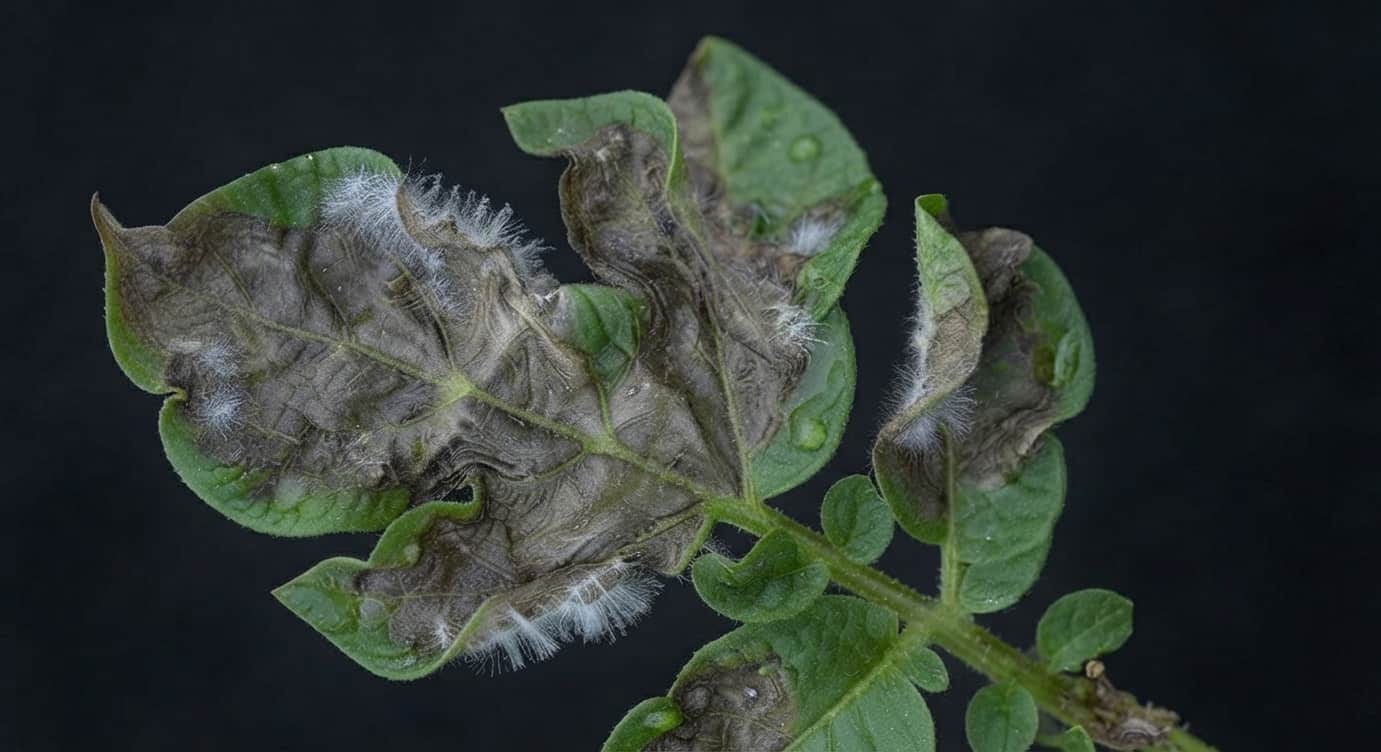
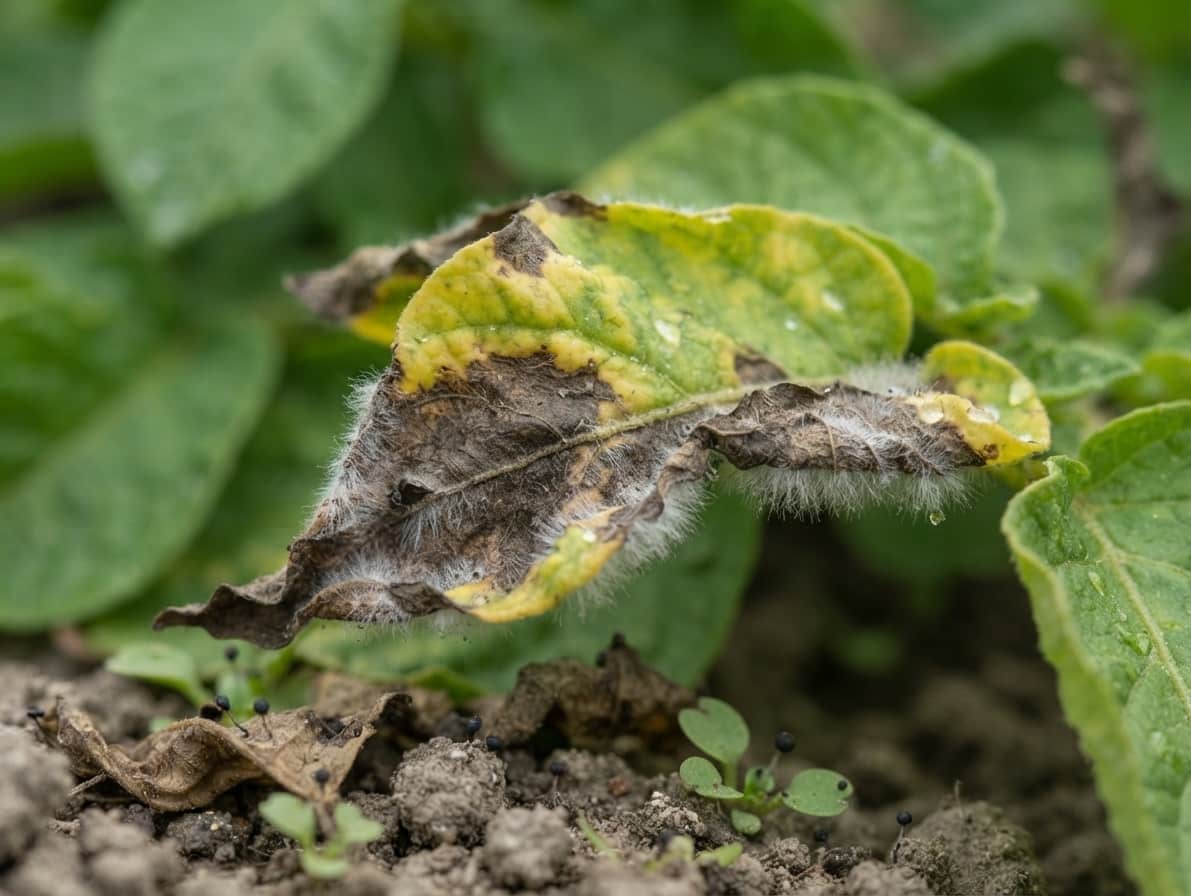
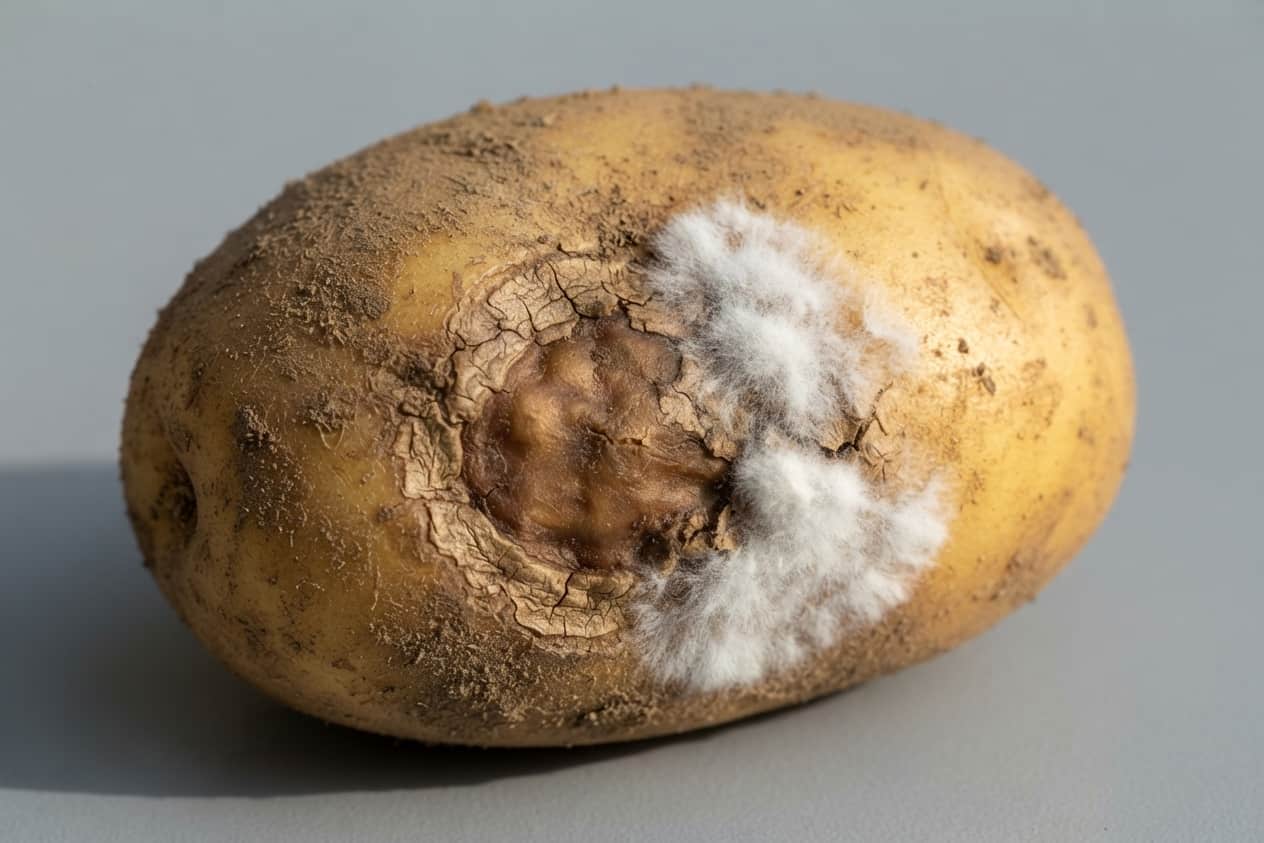
On leaves, the first warning is usually the appearance of olive-brown lesions with irregular, oily-looking margins, typically starting at the leaflet edges or tip. When ambient humidity is high — especially in the morning after overnight dew — a white, cottony mycelium can be seen on the underside, formed by the pathogen’s sporulation structures. If humid conditions persist, lesions spread rapidly and the leaf tissue becomes brittle, helping spread spores to neighboring plants via wind and rain splash.
On tubers, the damage is even more economically decisive, since it directly affects the marketable part of the harvest. The infection shows as a reddish-brown rot that penetrates from the skin inward, in irregular, diffuse-edged patches. This damage isn’t always visible at harvest: the pathogen can keep progressing in storage, so an apparently healthy lot can develop rot weeks later.
Causes and conditions that favor late blight
Phytophthora infestans depends on a very specific combination of environmental conditions to complete its infection cycle: high relative humidity, generally above 90%, and mild temperatures, roughly 50-68°F, sustained for several hours in a row. This is why late blight alerts tend to coincide with spells of intermittent rain, persistent fog, or heavy dew.
The pathogen also persists remarkably well from one season to the next. It survives in infected crop debris left in the field, and especially in contaminated seed tubers, which act as the main entry route into otherwise healthy fields. If your field is also carrying a deeper soil-borne problem, check our guide on soil disinfection without harming the microbiome. Once established, secondary spore dispersal by wind and rain splash can spread the disease rapidly within and beyond the field.
Best fungicide for potato late blight: QUELAFERT® FOS-K
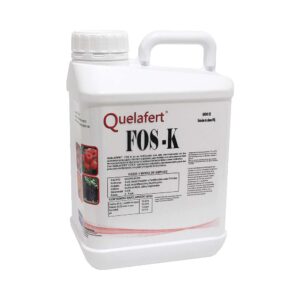
Against a pathogen with this spreading capacity, management can’t be limited to reacting once symptoms are visible: prevention and reinforcing the plant’s natural defenses play a decisive role. This is where QUELAFERT® FOS-K fits in as a specific tool within our fungicides range, the bioprotection line that at Quelagrow, as a fertilizer manufacturer and biocontrol producer, we develop against diseases like late blight.
How QUELAFERT® FOS-K works against late blight and Oomycetes
At Quelagrow we formulate QUELAFERT® FOS-K as a product very rich in phosphorus — supplied as phosphite, not phosphate — and potassium, two elements that, in this specific chemical form, activate the plant’s own defense mechanisms beyond their usual nutritional role. Once absorbed, phosphite moves easily through the whole vascular system, reaching both above- and below-ground tissue, giving it systemic action.
QUELAFERT® FOS-K boosts the plant’s defenses against fungal-type attacks, with action particularly marked against the Oomycete group — precisely the group Phytophthora infestans belongs to — and also against Phytophthora parasitica, responsible in other crops for collar rot, damping-off and gummosis.
This matters more than ever in a context where reducing reliance on synthetic fungicides is increasingly valued. Phosphites, as a group of substances, are characterized by low-to-no phytotoxicity and a much lower residue profile than many conventional fungicides, making them a coherent piece of sustainable agriculture and integrated pest management strategies.
How to apply QUELAFERT® FOS-K
(Pending exact dose and application schedule once the client confirms the technical data sheet.) The product supports both foliar and root application, allowing the treatment to be adapted to the crop’s growth stage.
Prevention best practices
Phytofortifier treatment pays off much more when combined with agronomic management that reduces disease pressure from the start. These are the cultural practices with the most real impact:
- Crop rotation: avoid planting potatoes or other nightshades consecutively on the same field.
- Plant spacing: excessive density restricts air circulation and keeps leaves damp for longer.
- Proper drainage: prevents waterlogging that favors both the pathogen and plant stress.
At Quelagrow we see these cultural practices as inseparable from integral bioprotection. Discover the rest of our bioprotection solutions.
Frequently asked questions about the best fungicide for potato late blight
What is the best fungicide for potato late blight?
There’s no single product that solves late blight on its own: effective management combines cultural prevention with phytofortifiers like QUELAFERT® FOS-K.
Does late blight only affect the leaves?
No. It affects both foliage and tubers, where rot can keep progressing even after harvest.
Under what conditions does late blight appear?
Mainly high relative humidity (above 90%) and mild temperatures sustained for several hours, typical of intermittent rain or persistent dew.
Is potato late blight the same disease that affects tomatoes?
Yes. Both potatoes and tomatoes are nightshades and both are susceptible to Phytophthora infestans. If you grow both nearby, monitor them together.
Can a plant with advanced late blight be cured, or is it only preventable?
Necrotic tissue doesn’t recover. Real management is preventive: reinforce defenses ahead of risk periods and remove heavily affected material promptly.
How do I tell late blight apart from other leaf spots caused by water stress or nutrient deficiencies?
The key is the white, cottony mycelium on the underside of the leaf — neither irrigation issues nor nutrient deficiencies produce that.